Kauai: What To Know
However, by the time King Kamehameha I died in 1819, Hawaii's socioeconomic system was already undergoing dramatic changes. Many of the ancient customs of the traditional "kapu" system were overthrown, and the burgeoning whaling industry and the missionary movement were beginning to alter the islands' former way of life.
Hawaii slowly became populated by mainlanders trying to make money off of the islands' natural riches. And as in many parts of the world, the indigenous traditions of the Hawaiian islands ultimately gave way to sometimes violent pressures from missionaries, to be replaced by Catholicism and Christian morality. By the mid-19th century, the sugar industry had taken hold of Kauai. Ladd & Company, a New England business with missionary ties, took hold of 980 acres of land at Koloa. This fertile area in southern Kauai was much coveted by sugar companies, and its prolific crop played a major role in the U.S.'s interest in annexing the entire territory of Hawaii.
By the late 19th-century, the United States was actively involved in shaping the islands' politics. Although the majority of Hawaiians opposed annexation, President McKinley signed an annexation agreement on July 7, 1898. Hawaii was finally granted statehood on August 21, 1959.
Typically, winter is the rainy season on Kauai, and the weather is less predictable than during the summer months. Often the island is pounded by rainfall for a week straight, and then the following week is sunny and clear.
The average coastal temperatures vary little from summer to winter, ranging from 77 degrees Fahrenheit in August to 70 degrees Fahrenheit in February. In higher inland elevations, however, the thermometer can drop to 30 degrees Fahrenheit on a cold winter night.
Check out the current weather conditions before you go.
Although contemporary culture in Hawaii is similar to that of the rest of the U.S., Hawaiians strive to preserve cultural traditions. Language and hula classes are common, and traditional arts and crafts thrive. The social tradition of giving flower necklaces, or leis, illuminates the richness of the Hawaiian culture. Different leis have different meanings. Tourists are given leis of plumeria, while a bride might wear a lei of pikake. There are special leis for hellos and good-byes, and each island has its own particular lei.
For dessert, try a local favorite, shave ice--it's like a snow cone but even better. Or, sink your teeth into some chocolate-covered macadamia nuts, available at nearly every drugstore, grocery store, and souvenir shop.
Most of the properties damaged by Iniki have been rebuilt, and many of Kauai's faster growing plants have again taken root. Although to the untrained eye the island's flora and fauna seem to be well on their way to recovery, the post-storm distribution of plant and animal life has changed. Since the hurricane, four species of endangered indigenous birds have not been spotted on Kauai, and it will take years for scientists to determine the long-range effects of Iniki on the island's delicate ecosystem.
Na Hula O Ka'ohikukapulani Hula Exhibition: This hula competition among the island's youngsters ensures that the ancient tradition of hula is carried to future generations.
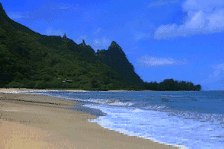
Location
The Hawaiian Islands are located just south of the Tropic of Cancer in the Pacific Ocean, 2,400 miles southwest of California. Kauai is the northernmost island in the Hawaiian Islands chain.
Geology
The Hawaiian islands were all formed by volcanic activity on the ocean floor of the Pacific. Each island is essentially a mountainous volcano or group of volcanoes that has risen above the surface of the ocean and expelled lava to create land mass. Kauai is the oldest of the Hawaiian islands.
History
Before annexation to the United States, Hawaii was once an independent kingdom. Each island was a separate domain until 1795, when the first King Kamehameha united all of Hawaii. The charismatic Kamehameha and a dynasty of his progeny ruled the islands for the next century.
Weather
The weather on Kauai is more dependent on location than on season. The southern end of Kauai is dry and mostly sunny year-round, whereas northern Kauai gets a bit more rain because of the moist northeasterly trade winds that hit the coast. Mt. Waialeale in the island's center receives an astounding 426 to 624 inches of rain per year, the world's record rainfall. When To Go
Any time is a good time to visit Kauai. High season runs from December to April, and the island tends to be more crowded during these months. Prices are generally less expensive during off season, and budget-conscious travelers often vacation here during the summertime.
The People
The population of Kauai is 55,100. There is no one ethnic majority. About 31 percent of Kauai's residents are Hawaiian and part-Hawaiian, 25 percent Caucasian, 24 percent Japanese, 12 percent Filipino, 5 percent Chinese, and 3 percent black and other Asian.
Cuisine
Hawaii's sizable Asian influence is evidenced by much of the islands' cuisine. A typical "mixed plate" for lunch comes with rice and macaroni salad, as well as your choice of an Asian dish such as chicken teriyaki (Japanese), beef with oyster sauce (Chinese), or kalua pig (Hawaiian). Kalua pig, a favorite of luaus, is a suckling pig slow-cooked in an underground oven. Dried salted fish is also a favorite, as is poi, a stew made from the taro plant. Indigenous fruits such as star fruit and breadfruit are used in many traditional recipes.
Recent Developments
Living in paradise has its price and 1992's Hurricane Iniki reminded Kauai residents of this unavoidable fact. The most powerful storm to strike Hawaii in a century, Iniki pounded Kauai with winds measuring more than 165 miles per hour. Thousands of trees were felled, more than 50 percent of the island's buildings sustained serious damage, two people were killed, and many more were injured.
Calendar of Events
Waimea Town Celebration: The town celebrates the anniversary of Captain James Cook's arrival in Hawaii with historical reenactments, parades, races, food fairs, and other fun-filled events.
Prince Kuhio Festival: A statewide holiday honoring Prince Jonah Kuhio Kalanianaole, a long-term Hawaiian delegate to the U.S. Congress and a vocal advocate of Hawaiian rights. Canoe races, a royal ball, and music represent just some of the planned festivities.
Buddha Day: Hawaii's Buddhist population is sizable, and this day is celebrated statewide with pageants, dances, and flower festivals.
Lei Day by the Bay: Most Kauaians wear leis on this day, and lei-making competitions pay tribute to the ancient art.
King Kamehameha Day: In honor of the king who unified the islands, Hawaii celebrates this state holiday with colorful parades and other events. Lihue stages its own parade.
Koloa Plantation Days: This is a week-long celebration of the history of the sugar industry in Kauai.
Kauai Tahiti Fete: Tahitian culture is celebrated with Tahitian dancers, arts, and crafts.
Kauai Country Fair: Held Labor Day Weekend at the Kauai War Memorial Convention Hall in Lihue, this is a typical country fair with a distinctly Hawaiian twist.
Aloha Week Festival: Hawaiians celebrate their culture with parades, canoe races, and other traditional contests.
© 1999 Travel with Aloha. All Rights Reserved.